
Every marketing campaign tells a story – but only if you can clearly identify where the clicks came from. That's exactly what campaign parameters are for. They attach structured information to a destination URL, enabling web analytics tools and BI reports to cleanly attribute which channel, creative, placement, or action actually drove results.
Without these parameters, many visits end up in catch-all categories like “Direct” or “Referral,” even though they came from newsletters, paid social, or partner campaigns. The result: unclear budgets, wrong learnings, and discussions about data quality instead of growth.
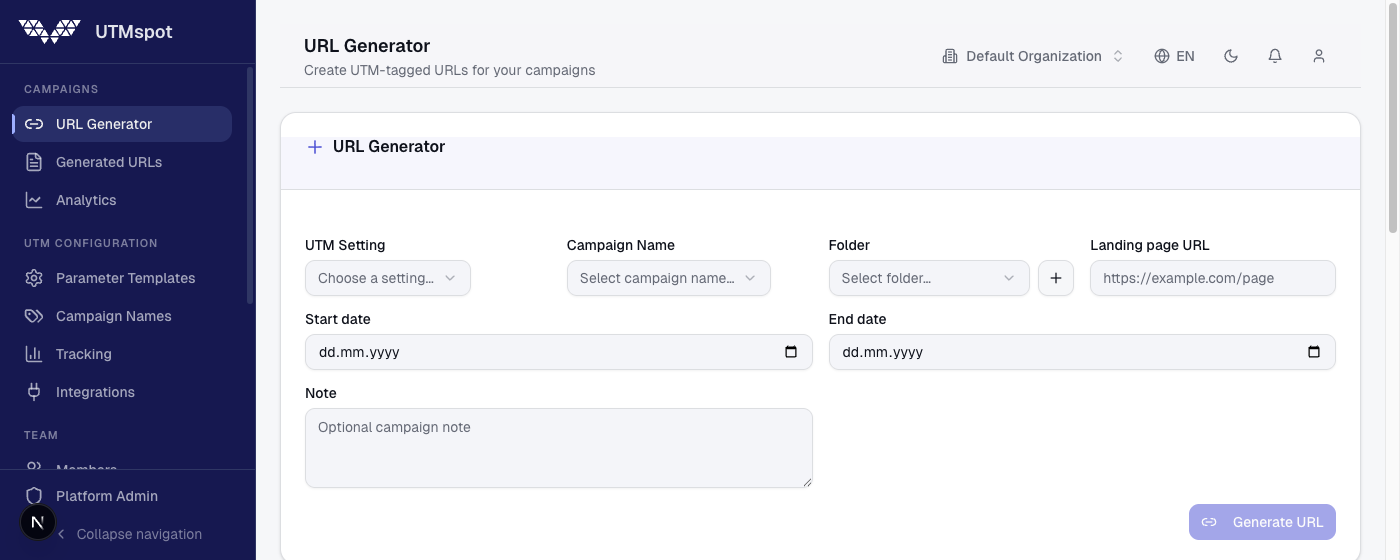
What Are Campaign Parameters?
Campaign parameters are structured key-value pairs that you append to links to uniquely tag campaign traffic. The most well-known are UTM parameters. UTM stands for “Urchin Tracking Module” and is historically closely tied to Google Analytics – but today many tools recognize them, including Matomo, Adobe Analytics, and other analytics platforms.
Typically, a regular destination URL is extended with parameters. When clicked, these parameters are passed to your analytics tool and stored as dimensions. This allows you to build reports like:
- Which campaign generated the most leads?
- Which ad delivers the best conversion rate?
- Which source provides high-quality traffic with long session duration?
The Benefits for Online Marketing, Web Analytics, BI, and Performance Marketing
The practical value goes far beyond pretty reports.
Clean Attribution in Day-to-Day Operations
If you're active on LinkedIn, Google Ads, Meta, newsletters, partner sites, and QR codes, you need clear naming. Campaign parameters create order and prevent campaigns from getting lost in your analytics.
Cross-Channel Comparability
With consistent parameters, you can cleanly compare paid social vs. newsletter, retargeting vs. prospecting, brand vs. non-brand. This makes budget decisions significantly easier.
Better BI Models
In Power BI, Looker Studio, or other BI tools, you want a stable data foundation. When parameters are chaotic, duplicates appear in your dimensions – for example, ten different spellings for the same campaign. Consistent parameters reduce data processing effort and improve insights.
Faster Optimization in Performance Marketing
Performance lives on iteration. If after two days you still don't know which creative or audience setup is working, you're losing time and money. Campaign parameters provide the bridge between ad platform, landing page, and conversion event.
How UTM Parameters Are Structured
UTM parameters consist of key-value pairs. The most important fields are:
- utm_source – The source, e.g.
linkedin,google,newsletter,partner_xyz - utm_medium – The medium, e.g.
cpc,paid_social,email,referral,display - utm_campaign – The campaign name, e.g.
brand_q1_2026orleadgen_webinar_february - utm_content – Optional, usually for variants, creatives, or placements, e.g.
video_a,carousel_2,header_link - utm_term – Optional, often for keywords, especially in search campaigns
https://example.com/landingpage?utm_source=linkedin&utm_medium=paid_social&utm_campaign=leadgen_webinar_february&utm_content=video_aWhat matters is not just that you use parameters, but that you use them consistently. Even small deviations like LinkedIn vs. linkedin or paid social vs. paid_social create separate rows in your analytics – leading to incorrect totals.
Common Mistakes and Why They Are Costly
Many teams start with a spreadsheet and the hope that everyone will stick to it. In practice, typical problems arise:
- Typos and inconsistent spelling
- Missing required fields
- Unclear naming logic – e.g., campaign named by date sometimes, by product other times, by channel elsewhere
- Duplicates – the same link with slightly different parameters
- No traceability of who created what and when
Once these errors make it into your web analytics, they are hard to fix later. You can partially map and clean them in BI, but that costs time and often becomes a permanent construction site.
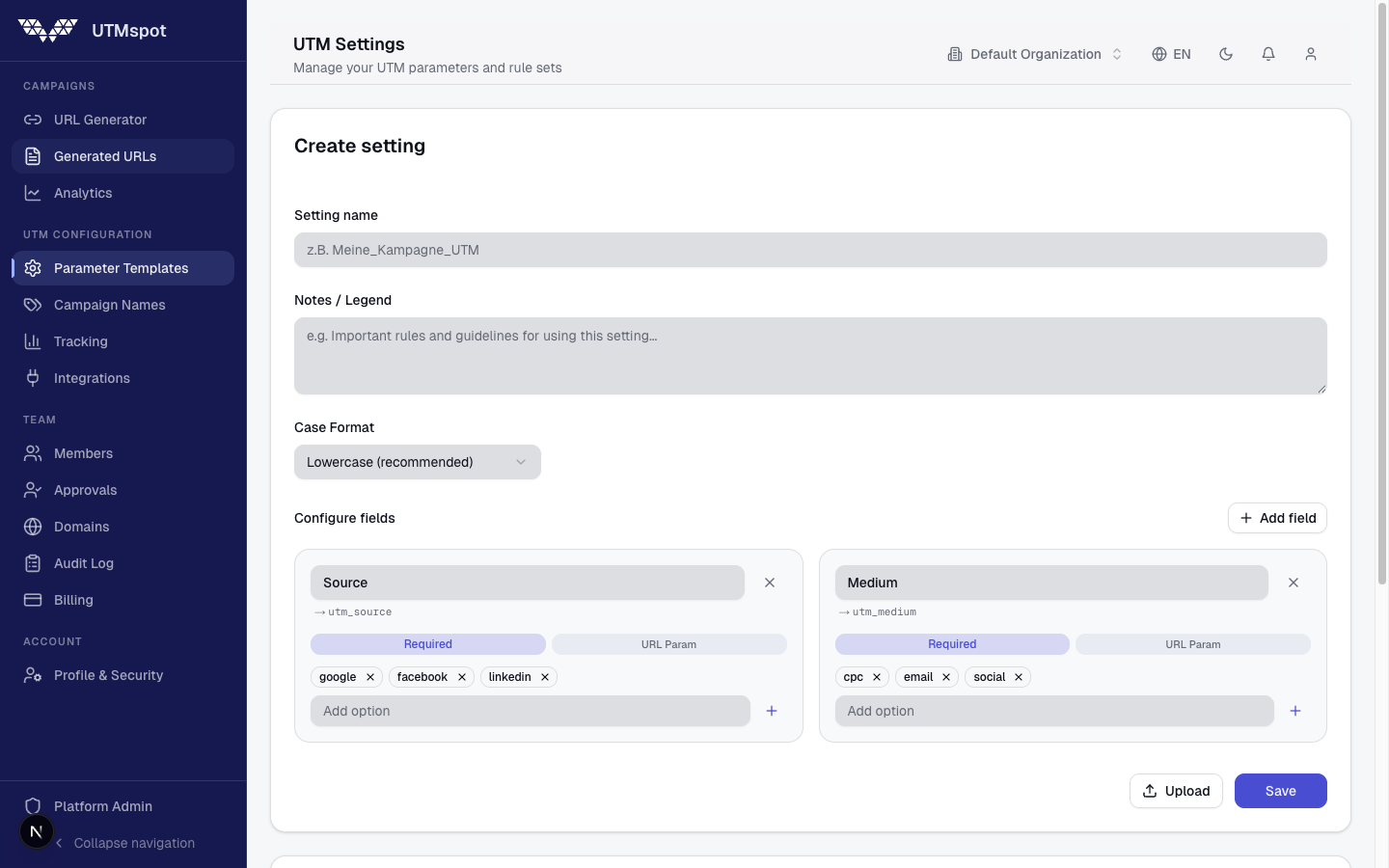
Governance as the Key When Multiple People Build Links
As soon as multiple teams, countries, or agencies are involved, governance becomes critical. Governance means: clear rules, binding templates, validation, and transparent responsibilities.
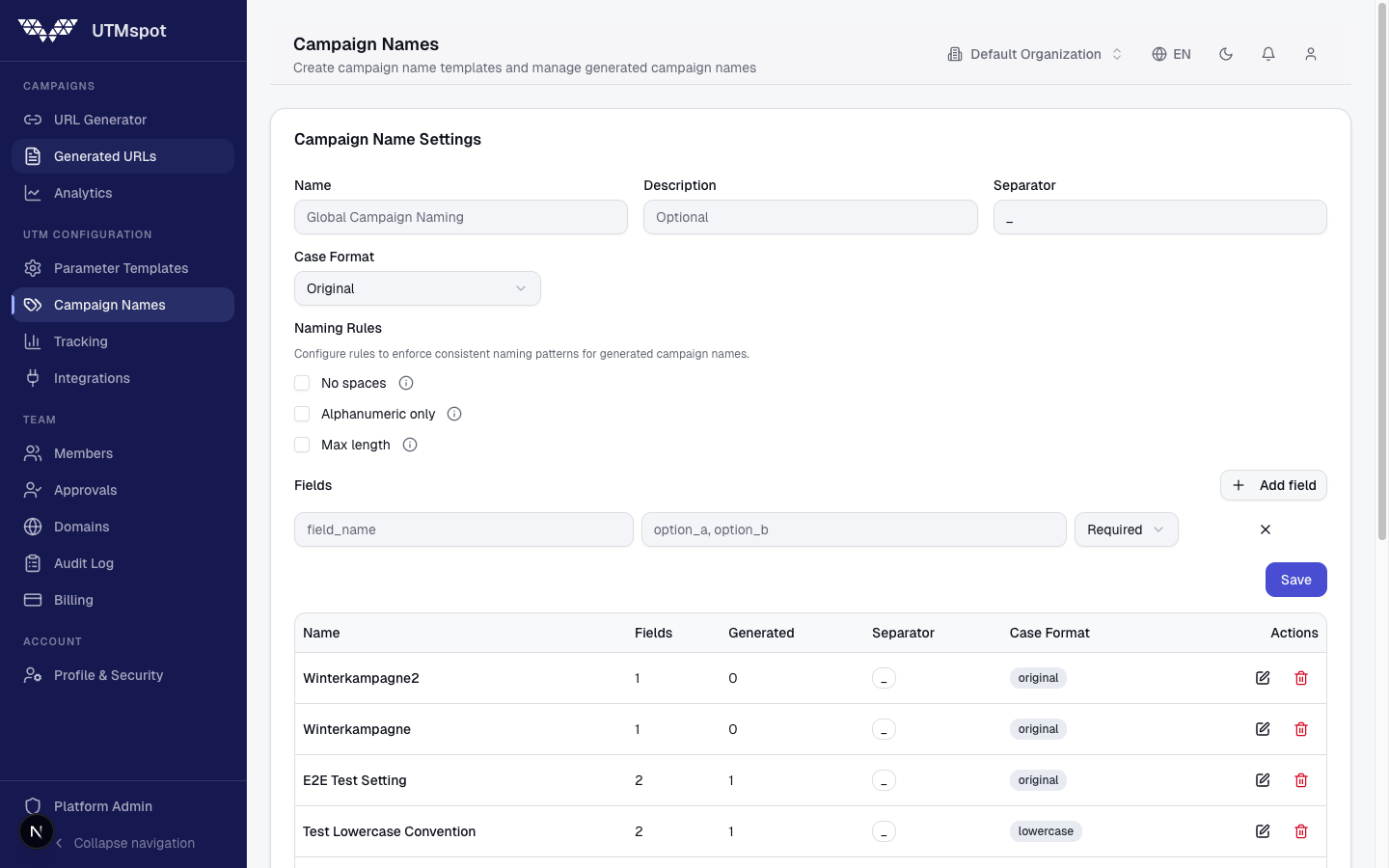
This is exactly where UTMspot comes in. The platform replaces error-prone spreadsheets with governed selections, naming conventions, and validation – ensuring campaign parameters stay consistent. It also supports team structures with roles and permissions, offers duplicate detection, export options, and audit logs.
This is especially well-suited for setups where online marketing, web analytics, and BI work closely together. Because marketing needs speed, analytics needs consistency – and BI needs stable dimensions.
Connection to GEO: Why Structured Parameters Also Help AI Search Systems
GEO in a marketing context is often understood as “Generative Engine Optimization.” It's about preparing content and data so that they are better understood and categorized by AI-powered search systems, assistants, and summaries.
UTM parameters aren't content SEO, but they improve the data foundation on which you make decisions. If you can reliably measure which content, claims, and entry points work, you optimize the pages faster – which in turn drives SEO and GEO effects. Additionally, consistent naming helps keep internal reports, dashboards, and knowledge bases unambiguous. That's an indirect but very real advantage.
Best Practices for a Clean UTM System
- Define a fixed taxonomy – Source, medium, campaign logic, and content logic must be unambiguous.
- Use lowercase and consistent separators – For example, only underscores, no spaces, no special characters.
- Set required fields – At minimum: source, medium, campaign.
- Version your naming rules – When logic changes, it must be clear from which date which rule applies.
- Connect analytics and ad platforms – A platform that supports integrations with common analytics tools saves coordination effort and improves data quality. UTMspot supports GA4, Adobe Analytics, Matomo, Mapp Intelligence, Piwik PRO, and more.
Conclusion
Campaign parameters are not a detail – they are the foundation for clean measurement. Those who use them consistently gain clarity about channels, creatives, and budgets – and can build web analytics and BI far more efficiently. And as soon as multiple people on your team create links, you need governance instead of spreadsheets. A platform like UTMspot addresses exactly this: with templates, validation, roles, audit logs, and integrations – turning campaign traffic into real, reliable insights.